Wednesday, June 2, 2010

Does Gender Equality Exist? by Sharon Dolan

The emotional, sexual, and psychological stereotyping of females begins when the doctor says, "It's a girl." ~Shirley Chisholm


Men and women are not equal and to my mind they never will be.


In June 1913 Emily Davison threw herself in front of the King of Great Britain and Ireland’s horse at the Epsom Derby. The moment was captured on film and for anyone who has seen it: it’s a gruesome visual nightmare. For she was, of course, killed by the horse.


Emily was a devoted, and some may say fanatical, member of the women’s suffrage movement in the UK. A movement that campaigned and protested for Universal Suffrage: basically it fought for the right of women to have the same voting privileges as men.


In 1928 Universal suffrage for all adults over 21 years of age was achieved.


The Pankhurst family, who have become an almost mythical family in the movement towards equal citizenship with men, led the movement.


You can imagine my excitement several years ago when I discovered that a friend’s great - grandmother had been in prison with one of the Pankhurst’s, during the suffragette’s infamous hunger strikes. She was not in prison for herself being a member of the suffragettes, but because being about to give birth, and being in an era before epidurals, she had drunk some alcohol to help numb the pain. Her payment for doing such a thing: Prison.


And perhaps therein lies the insurmountable obstacle to gender equality: childbirth. And that is one fact that can never be erased.


To be born female is to be born, in many respects, a commodity. From the smallest age we compliment little girls for being pretty, sweet, good around the house, and all things nice.


If a woman happens to be beautiful and also happens to be intelligent well then that is one of the most dangerous combinations alive. And it will not, in nearly all cases, ever make her happy. By contrast looks and brains in a man just make him more attractive and winsome to everybody.


For men are born with an advantage.


But what about when this ‘advantage’ is not just an advantage like any other: being beautiful; being intelligent; being talented, but one which is used to victimize those that were merely born the ‘the other sex’.


I sat down to write this blog entry and realized I don’t know what to say, do, or write. I don’t know what you can say about such an endemic human rights issue that crosses, culture, race and wealth.


Whether that is rape, acid – throwing, honor killings, female genital mutilation or domestic violence.

The image that it portrays of the culture we have created for ourselves shows itself very clearly. Some are clearly more equal than others: A whole 50% to be precise.


‘At least one out of every three women has been beaten, coerced into sex, or

otherwise abused in her lifetime’.


As a child many of us witness domestic violence.


We all know people whose childhood was blighted by this horrendous reality.


There is a culture of silence that surrounds domestic abuse, and I don’t think any statistic will ever truthfully tell us how big the actual problem is.


The very same boys who are outraged at the abuse inflicted on their Mother often go on to impose similar abuse in their own adult relationships. And the same is true of girls. Often times the daughters of domestic abuse victims grow up and become entrapped in abusive relationships.


Children, who have witnessed the sins of the fathers, can often too actively reject the family where such horrendous events occurred.


As adults we demand explanations for the past. We want to know why it happened, and why it was allowed to happen. We don’t understand why people stay and put up with it. We often place the blame on the original victims:


‘You stayed! You put up with it! I wouldn’t. I never would. Why did you do it? Don’t you know what it has done to me?’


"To the victor go the spoils" goes the war cry. In a world where over half the human beings, are made vulnerable by virtue of their very gender. There are no victors; only spoils. And we should be ashamed of ourselves.

Monday, May 24, 2010

Abandoned Again? Chad Forces the UN Out of the Country

Abeché, Eastern Chad

May 23, 2010

We have begun our work on the ground in eastern Chad and in early days much of our focus is on the impending decision of the UN Security Council about the future of the critical UN mission here. Under pressure from the Chadian government, and with the conspicuous absence of the usual strong influence of Chad’s former colonial power, France, the Security Council is poised to agree to begin a pull out of UN troops from the east of the country, to be completed by mid-October. It could very well prove disastrous for human rights protection, development projects and overall security. And at this point in time it seems near irreversible.

My friend Celine Narmandji, a remarkably tenacious women’s human rights defender who I’ve worked with on missions here in the past, put it very well when we met for lunch right after my arrival in Chad. She said: “We were abandoned before. We’re going to be abandoned again. The good news is that in between, for a short while, the world did care about the situation in eastern Chad.”

Right she is, but we need better news than that.

I have been going back in my own mind, repeatedly, to the many women, men and young people I met during my first Amnesty mission to eastern Chad, in late 2006. They too talked about abandonment: in the face of a relentless wave of violence, much of it orchestrated from across the border in Darfur, hundreds of villages were razed, thousands of people killed, untold numbers of women and girls raped, and close to 200,000 Chadian chased from their homes.

They felt abandoned by their own government and the rest of the world. And they were – there was no UN mission on the ground at that time. And Chadian authorities, who have long neglected and played politics with the east of the country, did nothing to prevent or respond to the devastating human rights violations. Abandonment was the right word.

Amnesty and others worked hard to end that abandonment. AI members wrote letters, signed petitions and spoke out. And in March 2008 a UN mission, complete with military troops, began to fan out across this isolated and troubled region with a strong Security Council mandate to protect civilians. It was not easy. The UN mission faced numerous challenges and shortcomings – many of which Amnesty publicized, including after a mission I was part of back to the east last year. But now, just as the mission has begun to solidify and truly make a difference – the Chadian government has pulled the plug and the Security Council has meekly gone along for the ride.

The mandate of the current mission is set to expire on Wednesday of this week – May 26th; just 72 hours from when I’m recording this message. The writing is on the wall – a draft of the new resolution is circulating widely now, laying out a timetable for the UN’s quick withdrawal and taking away from the reduced numbers of UN troops that will remain for the next several months their mandate to take action to protect civilians. It is expected to be adopted before Wednesday.

Even as the hours draw to a close we must continue to press key governments – particularly France – to step back from the brink and refuse to go ahead with a precipitous UN pull out from a country that is, at best, beginning to enjoy fragile and very tentative improvements in human rights protection and security on the ground. I hope you will respond to AI’s email action targeting French president Nicolas Sarkozy.

It does appear that minds are made up.

But we are activists.

We certainly do not believe in abandonment.

And we do not remain silent – whatever the odds.

Friday, May 21, 2010

Climate Justice and Human Rights – Can’t See the Wood for the Trees by Ciarán O’Carroll


Amnesty International prides itself on being impartial. It promotes, always, the idea that there are two sides to every story. It takes a calm, logical and rational approach to the reporting of human rights violations.

During the period 1976 -1983 the South American Country of Argentina endured a period of military rule. A period that has become known as the: ‘dirty war’ (Guerra Sucia). It was, in effect, a Junta.

During this time the right wing government were responsible for the disappearance of several thousand left – wing militants. This included revolutionaries, trade – unionists, students, journalists, and all out leftist guerrillas and sympathisers.

In 1976 Amnesty International released its report on Argentina, a breakthrough account of the ‘dirty – war’ atrocities that were being carried out by the state.

Amnesty went on to win the Nobel Peace Prize the following year.

While this report gives an accurate and unbiased report on the atrocities. It fails, to my mind, to ask the other big questions. No light was shed on ‘why’ the mass arrests and murders were actually occurring.

The 92 page report fails to mention that the military dictatorship were in the process of radically remaking the economy. That they were planning on lowering wages and increasing prices in direct contradiction of the right to food and shelter, as it is enshrined in the UN charter of human rights.

So while Amnesty’s report accounted for the Argentinean junta laws and decrees that violated civil liberties, it made no mention of why the junta needed them. Which was in order to suppress the population so they couldn't revolt at their economic decrees.

Over thirty years later, in 2009, Amnesty International began campaigning on economic, cultural and social rights with the launch of the ‘Demand Dignity’ campaign.

The mantra and aim of this campaign is to “to end global poverty by working to strengthen recognition and protection of the rights of the poor.” It rightly acknowledges that the global economic crisis is driving millions more people into poverty and placing them at increased risk of human rights violations such as food insecurity or forced eviction.

Is there not a key part of the picture missing?


In 1976 Amnesty failed to mention economic injustice as a cause of the human rights violations.

In 2010 are we failing to mention climate injustice?

There is an icon of climate change: The image in the distance of the polar bear on the melting glacier. We all have seen it at some point or other, and think to ourselves: What will happen to our planet in the future?

We all hear scientists and environmentalists talk about Caron Dioxide and global warming. But the truth is we don’t really understand much about what is being said?

However if we open our eyes, and take a look at the world around us, the effects of climate change are everywhere. It is all too easy to see that climate change and human rights are inextricably linked.

In Africa human rights issues that impact the population on a daily basis: health, food security, work issues and women’s leadership. It is clear that most, if not all, of these are linked to climate change.

The stories of what people have had to endure, are literally heart breaking:

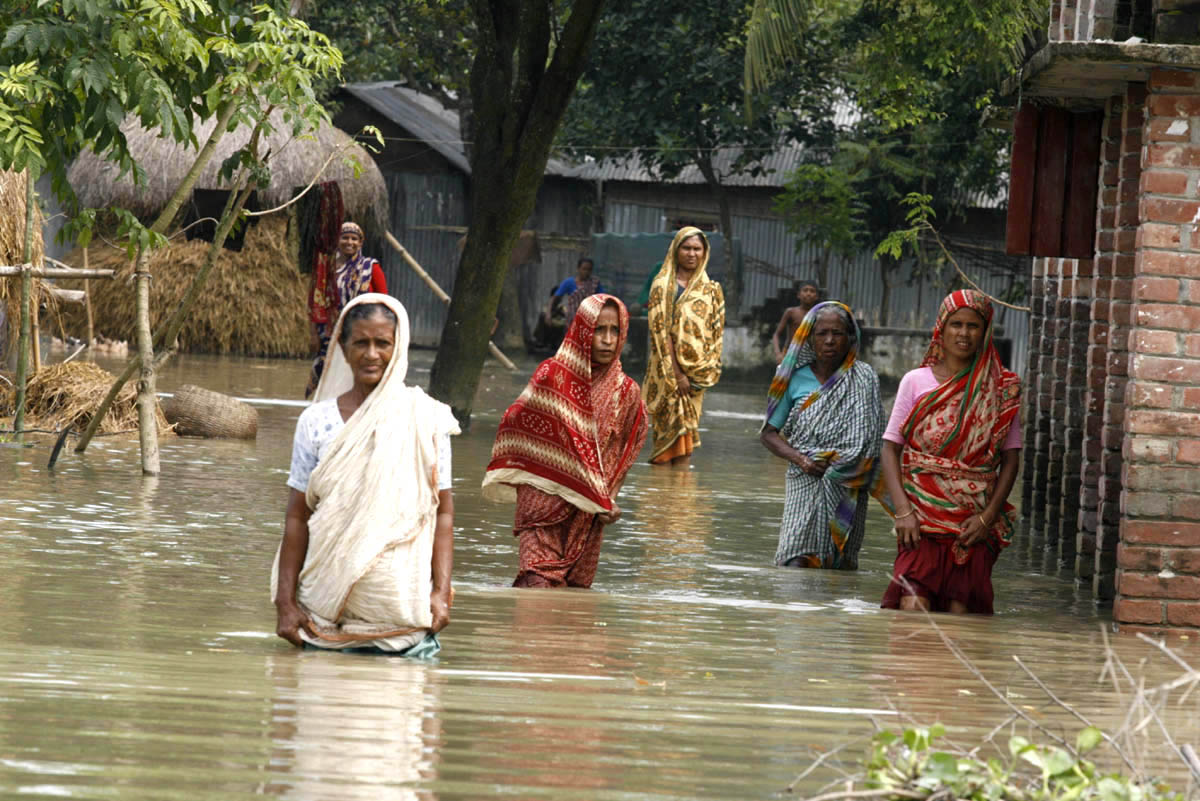
Mukelabai, 25, is still stunned as she looks at what remains of her home. ‘We put all our children in the canoe and paddled about 25km. We could not save our crops, so we have no food. We are eating nothing.’

Mukelabai Liywalii, whose family was driven out of their home by floods, Zambia, April 2009.

‘Especially when harvests are not good, girls are used to generate income. Some are forced to get married very young so the in-laws will bring bread and butter to their homes.’

Jacqueline Ng’ambi, project officer for the Maphunziro Foundation, Malawi, 2008.

How are we as human rights activists supposed to effectively campaign for justice on housing or education for people like Mukelabai or Jacqueline, without addressing climate change as a key factor?

Mary Robinson, a leader in the climate justice movement says:

“The starting point for climate justice is to acknowledge the clear injustice of the fact that many decades of carbon emissions in richer parts of the world have led to global warming and caused severe climate impacts in the poorest countries”.

So as Amnesty now looks to the future with its exciting new Demand Dignity campaign. We must be careful not to repeat the mistakes of the Argentinean report of 1976. See the whole picture. Don’t just ask ‘what’, but also remember to ask ‘why’.

Climate justice, and human rights organisations share the same principals and must work together, if either is to achieve their goals.


The beginning of that long and winding path, to success, is for human rights groups to acknowledge that climate change is a fundamental cause of human rights violations across the globe.

We as members of Amnesty International need to call for this acknowledgement.

Wednesday, May 19, 2010

Power corrupts; absolute power corrupts absolutely

"Unlimited power is apt to corrupt the minds of those who possess it" William Pitt

Power corrupts. I have no doubt about it. Absolute power is so corrupting that it can result in the deaths of numerous, often nameless, faceless individuals. History tells us this. Millions of people have lost their lives under totalitarian regimes: France’s reign of terror; Hitler’s Germany; Stalin’s purges.

None of us are perfect; we all make mistakes. By extension no country or political regime is perfect. The political regime, which we in the west unanimously refer to as freedom, democracy, is after all far from being a perfect construct.

As we jumble through life making mistake after mistake, we are often reminded of the wisdom that states: don’t worry you will learn from this. Yet we don’t. As the old saying goes ‘history repeats itself’. And it repeats itself over and over again.

There is no doubt in my mind that this very minute, somewhere in the world, a baby has been born who is destined to loose their life under a totalitarian regime.

And next week another baby will be born who is destined for the same path; and next month, and next year. If we as humans understand ourselves, in any way, we know this to be true.

During each time in history, there are regimes that represent to us everything that is repressing, domineering, inhuman and violating. Everything utterly repulsive, to the five senses, of those who wish to promote everything Amnesty International’s candle stands for: hope, love, tolerance, kindness.

Since the Islamic revolution of the late seventies, Iran has been a theocracy. A theocracy intolerant of, any and all, criticism; one that restricts the freedom of thought, action, religion, and life style of its citizens.

When it comes to the death penalty Iran leads the violators.

Iran executed the most juvenile defenders of any country in the world last year.

When Amnesty launched its annual report on the death penalty a few months ago, it revealed that Iran executed the second highest number of people, in total.

On the 9th of May 2010 they added five more people to their death toll. And I for one do not want them to be the nameless, faceless victims, of intolerance.

Those executed are:

1. Farzad Kamangar
2. Ali Heydariyan
3. Farhad Vakili
4. Ms. Shirin Alam-Hooli
5. Mehdi Eslamiyan

It is shocking to be aware of the fact that Ms. Shirin Alam Hooli’s case was still in the process of appeal and no judgement had been given.

Each one had a voice worth hearing, each one loved and was loved, and today those they held nearest and dearest are mourning. However the even more shocking truth is that their families were not even made aware that they were going to be executed.

Power corrupts. Power also fears. If you were all powerful, and ruled over perhaps millions of people what do you fear most?

That is will be taken from you!

And in this fear and in this uncertainly we aim to instil likewise emotions into those that we perceive as a threat: into those who wish for, and fight for, freedom and democracy.

Democracy is far from perfect, but there is a reason that it is: the worst form of government except all the others. Power, in the hands of any unquestioned person, or any unquestioned regime, ends in bloodshed.

Tuesday, May 11, 2010

The Election and The Pope by Sharon Dolan


“We have just enough religion to make us hate, but not enough to make us love one another” – Jonathan Swift


Article 18 of the Universal Declaration of Human Rights: Everyone has the right to freedom of thought, conscience and religion.


There is a hung parliament in Great Britain. If ever there was a walking advertisement for proportional representation, well people now we have it. The election has dominated the news coverage, on both sides of the channel, over the past number of weeks. Something else has also appeared in the news over the last number of weeks, which had my ears prick up.


This autumn, Pope Benedict is popping by Britain’s way. And as with all official visits, the foreign office has been busy out planning the meet and greets, the kissing of the babies, and the Queen.


A memo that was released told of the British foreign affairs department ‘ideas’ for this upcoming event. It contained a list that would, not only be offensive to the Pope himself, but to many practicing Catholics. Among the ideas, that were tooted, where references to the opening of an abortion clinic, and the blessing of a gay marriage.


I wish I could say I was completely appalled by this memo, but to be honest I wasn’t. Vaguely amused? Yes.

Everyone under the sun could see that no one was, in any way seriously, thinking about making these ‘ideas’ a reality. The ‘grave’ error was that civil servants saw fit to write down what had obviously been a moment of fun.


Civil Servants serve their country. They are employees of the state. Whatever the make up of the new British government, the country will in effect be run, as is every country, by the self same people who wrote that memo. As such they represent over 60 million British citizens, whether they be catholic, protestant, muslim, hindu, agnostic, or atheist.


We all know that these times are not the Catholic churches finest. Abuse scandals loom large on a global scale, and the church, in general, has taken more then a few knocks and attacks. Not least here in our own fair island.


That civil servants should display such a dismissive attitude towards a religion, that is the chosen faith of millions of ‘their’ citizens, is to me something that is regrettable, ill thought out, and inappropriate.

The Catholic religion is not the only religion that has had its name in the news. The Islamic fate has made an appearance as well.

Last Friday I read that Belgium has banned the wearing of the burqa in public.

The law was passed unanimously in the politically fragmented country. It outlaws appearing in public "with the face fully or partly covered so as to render them no longer recognisable."

If you are caught wearing the burqa you could be fined between €15 and €20, and possibly be jailed for up to a week.


France is also to begin considering a similar draft law in May.


Amnesty International, attacked the bill saying that it set "a dangerous precedent."

"A complete ban on the covering of the face would violate the rights to freedom of expression and religion of those women who wear the burqa or the niqab,”.


This has brought out conflicting emotions in me. On one hand I do not believe that the state has the right to interfere in either the private life, or indeed the religions views, of any citizen.


My belief in this aside I have questioned, many times, the existence of the burqa and the niqab. Whether it is indeed a choice made by each woman, willingly and of her complete free will. But I will be the first to freely admit that, as someone raised an Irish Catholic, it is not something I know enough about, or possess enough experience of, to give a definite opinion. I will continue to remain in my state of ambivalence, but the passing of this law has troubled me.


Everyone has the freedom to choose to belief in a god, or not; or choose to worship in an organised religion of their choice, or not.


I, for my part, am an agnostic. I respect the views of anyone who believes in a faith. I just choose to not partake.

Whatever our personal opinions and feelings on a topic, the choices made by others, as long as they are made freely, should be respected.


What we don’t know frightens us. It makes us uncertain and as a result breeds prejudice. And nothing, ever, shows the dark side of human nature more than our views on another’s religion.

Tuesday, May 4, 2010

The Beautiful Game – by Ciarán O’Carroll


Every four years, football fans, and foes, gather together to cheer, shed tears, and no doubt drink, to one of the greatest sporting events around: the FIFA Football World Cup.

This year, this most magical of events, will be held in South Africa.

Preparations have been underway, for a number of years now, and the South African government, has lavished an estimated €1.3bn on the building of world-class venues. The most spectacular of all is apparently to be, the stadium itself.

For most men, and quite a few women, the events will be the highlight of the summer festivities 2010.

However there is one place where it will not be greeted with euphoria.
The people of Tin Can Town (or Blikkiesdorp), South Africa, are boycotting the world cup. And no it’s not because they are outraged that Henry’s handball went unpunished.

In 2008 the South African Government built Tin Can Town. It was built for an estimated €3.25m. Its sole purpose: to provide “emergency housing” for about 650 people. The re – housing took place because those people had been occupying buildings, in the way of a world cup development: The N2 Gateway Project.

As was the case with the Chinese Olympics in 2008, the poor and vulnerable locals were viciously suppressed and evicted from their homes, so that there can be an uninterrupted view of the ‘beautiful game’.

Today there are not 650 people in the settlement; there is more like 15,000. They all struggle to live, in around 3,000 wood and iron structures. More are arriving all the time. At the time of its construction city officials said the site was designed to cater for, at most, 1,667 families.

The reality of life in Tin Can Town can often be brutal. Families of six or seven people are crammed into tiny living spaces. There are no shower facilities; illnesses such as HIV and Aids are rampant. Toilets are found inside grim concrete cubicles, so small, the locked door presses against the user’s knees.

Police and Apartheid era riot vehicles are stationed permanently at the only
entrance.

The testimony from the locals is damning:


Badronessa Morris, 47, complained: “The police treat us like animals. They swear at us, pepper spray us, search us in public, even children. At 10 o’clock you must be inside”

Blikkiesdorp resident Samsam Ahmad, a Somali refugee, who has two small children fears death and cannot sleep. “We were told we’re going to get protection but our lives are in danger. Every night people knock on our doors and say they want to burn us. My children’s lives are at risk. We don’t sleep at night and don’t know how long we will stay here,” says Ahmad.

This June, down the road from where Basronessa and Samsam live, football players will be relaxing in their training resort with all weather pitches and a spa.

Henry, and that handball, is annoying. But if there is ever a reason to be angry it is because 2,500 people living with AIDS, have no medical care. Be angry because parents send their children to school starving because they can’t afford to feed them; and because people are treated like animals just for being poor.

In solidarity with the residents of Tin Can Town I’m boycotting the world cup. Injustice cannot be worldwide sporting entertainment on TV, not in China, not in South Africa, not anywhere.

Monday, April 26, 2010

He who does not weep, does not see

Chad is in Africa. It is a former French colony. According to the United Nations, it has been affected by a humanitarian crisis since at least 2001.


Right now there are almost 500,000 people living in camps in eastern Chad, including a quarter of a million refugees who fled violence and ethnic cleansing in neighbouring Darfur.


They are under regular attack from armed groups, Chadian rebels and bandits. Rape, murder and the recruitment of child soldiers happen every day.


But the Chadian Government is unable and unwilling to protect the camps. Without protection humanitarian agencies cannot work in the camps and they are open to attack. Refugees will have no aid and could be forced to flee again.


The only protection these people have is a small force of almost 4,000 UN peacekeepers, among them around 400 Irish troops.


Their UN Security Council mandate to be there runs out on the 15th of May and the government of Chad does not want the mandate renewed.


Without this protection, we face the possibility of a humanitarian crisis involving hundreds of thousands of people with the potential to engulf Chad and Darfur.


All too often we act too late. In everything we do. A catastrophe happens, and we think: oh we have to do something about this. Obviously we, they, it are failing; lets fix the failings. And that is what we are good at as humans! Mopping up after the big explosion, whether that is in our personal life, or on a much larger global scale.


But every now and then we can intercept. It can be: what can I do to prevent ANY suffering, rather than what can I do to prevent MORE suffering.


We need the UN Security Council to stand up to the Chadian Government, demand the peacekeepers stay and ensure they are given the troops and the equipment they need to protect the camps.


France is the lead member of the UN Security Council on this. It was France that argued for troops to be deployed to Chad in the first place and it is France that holds the key to persuading Chad to accept the peacekeepers.


We need your help. We need you to take action.

Go to http://www.amnesty.org/actforchad/ to write to French President Nicholas Sarkozy.

We have 20 days to save hundreds of thousands of lives.

Thursday, April 22, 2010

Amnesty’ Conference 2010 and Troy Davis by Adrianne Wyse


I trekked into the 2010 Amnesty Conference to support a friend. Now don’t get me wrong, I’m a member of Amnesty International (AI) and fully support everything that they do. I just haven’t exactly been an active member in recent years. But this year’s National Conference has left me determined to get back involved with the organisation and do everything I can to help.

The moment I arrived I was thrust a blue “I am Troy Davis” t-shirt. We traipsed down to O Connell Street all clad in blue for a photo shoot. I was really surprised by how effective a method of campaigning this was. Numerous people came up to ask questions about Troy, and apparently some people thought we were on a stag…. slightly odd. I guess it made a pleasant change for people, accustomed to being accosted by over enthusiastic campaigners with fliers and leaflets.

I have to be honest at this point and admit, that I had no idea who Troy was before the recent convention. I had asked another member for some background before we had headed down town. Thus, I found out he was a prisoner on death row in the US, who for 20 years has maintained his innocence and fought for a fair retrial but never received one.

The closing portion of the weekend’s events was dedicated to Troy, with his sister Martina addressing the Conference. Naturally I expected this to be interesting, but I think everyone in the audience was unprepared for the effect it would have on us. The theatre had filled up quite a bit with interested parties, members and non-members alike. Martina started, with a film describing the situation that led to her brother’s arrest and eventual conviction.

Troy was convicted of killing a police officer in August 1989. The circumstances leading to his arrest are highly questionable. Amongst other irregularities plaguing the case, 7 of the 9 witnesses used to convict him have recanted their stories.

What struck me most, as Martina began to talk of her journey and that of her brother, was how fresh it all sounded. It has been 20 years. She must have told this story, his story, thousands of times, but still spoke with such conviction and clarity, that most in the audience were moved to tears. To say her tale is moving and powerful is really not doing it justice. Her resilience, courage and determination are simply incredible.

Hearing her talk about her brother, you realise that this strength and determination comes from her love for him. And you cannot but warm to him, when you hear this love in her voice. His tale is truly horrifying. To hear that he has been, three times, within 90 minutes of being executed is unbearable.

The death penalty is abhorrent to me in all circumstances. But to think that an innocent person could be killed in this way is simply horrific. That is not justice, nor could it ever be.

I can’t even begin to comprehend what Troy and his family have gone through. What is even more terrifying is that while I go on living my life, even writing this article, he is still locked up and this nightmare continues for him. I read up on him in the week after. What is clear from letters he has written to people, is that he is not fighting for himself and neither is Martina. Troy sees himself as one of many people who have suffered injustices at the hands of their government and he fights for all of them.

I wonder what I would do in her circumstances. When Martina joined Amnesty, she didn't realise that the life she would end up fighting for would be that of her brother. I like, Martina, have joined Amnesty, to fight for the rights of other, of distant people. Like Martina, I have a brother that I love dearly. But a brother who could, in Martina’s words, “be in the wrong place at the wrong time”. I can only hope that I would have the same resilience and strength as Martina to keep on fighting for him. And in the meantime, I will fight for Martina’s brother, Troy Davis, and hope that one day he will be free.

Wednesday, April 14, 2010

Jack Bauer and Cruel and Unusual Punishment by Sharon Dolan

So this week I’ve been learning about International, European, and Irish Human Rights law: In particular the European Court of Human Rights. Established under the European Convention on Human Rights (ECHR), in 1950, to monitor respect of human rights by the states in Europe.

Learning and reading of the cases the courts hear, and have ruled on (did you know that over 50% of the cases heard are brought against the Russian Federation) has had me thinking about the concept of justice, and fair and open trails.

After all the legal system exists because mankind created it. It continues to exist because we continue to see it as the ‘best’ form of ‘justice’.

Traditionally, to us in the west, the image of Lady Justice sits as a mascot to the judiciary. Justice is depicted as a goddess equipped with three symbols of the rule of law: a sword symbolising the court's coercive power; scales representing the weighing of competing claims; and a blindfold indicating impartiality. And it is the last one, which is most universally known: justice is blind.

You do not have to prove innocence; you simply have to prove reasonable doubt.

As Amnesty, are all too aware, the death penalty, is a ‘punishment’, often handed down by courts in certain countries. Amnesty International is whole-heartedly, and one hundred percent, against the death penalty.

To me this is a black and white issue. The death penalty should never be used. It doesn’t prevent crimes and it essentially, in my view, contradicts what we most believe in. What if an innocent person is executed? How can you ever be 100% certain?

And in my learning, and through discussions with others, I discovered that when it comes to certain issues, such as torture, the group, if not each individual, is completely divided.

Yes torture is wrong. Of course it is. Debate over. Never to be discussed again. However then you read cases where torture has been used to extradite a confession, with the resulting effect that the lives of 10s, or maybe even 100s of people are saved? And someone says the inevitable: Well if it was your child in danger, you wouldn’t just ‘condone’ the torture; you’d probably do the torturing yourself.

So that’s my question today! Where do we draw the line with things like torture? Who gets to decide? And is one life just as important, or even more so, than 2 or 4 or 10 or 100 or 1,000,000.

We may know, or we strongly suspect, that a lot, if not all, of the world’s security services have used torture as a means of eliciting confessions.

We can never be sure, but we can be fairly sure they have, do, and probably will in the future. We are also aware that the information has been used to prevent terrorist atrocities, and further loss of life.

The European Court have heard cases like this, and in many cases they have ruled that the treatment endured was torturous, or cruel, or deliberate, and have on occasion ruled in the plaintiff’s favour.

In December 1977, there was a landmark case that marked the first time a government had taken another government to the European Court. And it was our very own government who took a case against the United Kingdom. The Court ruled that the government of the UK was guilty of "inhuman and degrading treatment", of men interned without trial, during the Northern Irish troubles. The Court found that while their internment was an interference of the convention rights, it was justifiable in the circumstances; it however ruled that the practice of beating prisoners, and the techniques used, constituted inhumane and degrading punishment in violation of the convention, although not torture.

Yes torture is wrong, and yes the torturers should be held accountable for what they have done, but where I reach my sticking point is: the life saving results of the torture. If one life is saved then that is two parents, numerous siblings, a whole family and a whole gaggle of friends who are saved from suffering. If it were your parent, sibling, friend, child or lover, would you consent to someone being tortured to save his or her life? Because it is a question I just can’t answer.

Thursday, April 8, 2010

Why do I have to learn algebra?

Article 26: We all have the right to education

It’s in the Universal Declaration of Human Rights (UDHR). It’s the Millennium Development Goal 2: Achieve universal primary education. We are told repeatedly of the value of education. It has been said often; and it has been said loud. It changes lives.

But we all wake up some, or most, mornings and wish we just didn’t have to go to school. We do not like that teacher. We do not like this subject. We do not want to get up at 7 o’clock in the morning. Some days we just can’t be bothered. And how on earth will algebra ever be of benefit?

For like all things that we have, and can have: we take it for granted.

The right to education in the west is, often, a non-issue. We are all required to attend school until we are 16 years of age, because years ago a government decreed that that was the way it was to be.

But in many countries throughout the world the obstacles that can hinder, a child’s, opportunity for education can range from the insurmountable, to the seemingly insignificant and minute. The list is literally endless. The school is too far away; they have to work; free and compulsory education does not exist in their country; they cannot afford schoolbooks; they can’t attend school because there is no clean lavatory.

To be educated is often times the only way to better yourself. JK Rowling, her of Harry Potter fame, once said that even though, at one stage, she was unemployed and living on benefits, she knew that she would be fine, and would avoid ‘the poverty trap’, because she had one thing going for her: she was educated.

There are very few of us, who will ever be able to attain an adequate standard of living as adults, without first being educated. Imagine for a moment that you couldn’t read, or that you couldn’t do simple maths? What job could you do? If you were sick you couldn’t even read the instructions on a medicine bottle. You would, in effect, have a disability.

Education may allow us to read about, and question, many theories and ideas, but the fact that we can even read them, in the first place, means that we have been educated.

In India last week, eight years after they amended the constitution to make education a fundamental right, the government implemented a historic law to provide free and compulsory education to all children from 6-14 years of age.

The 86th Constitutional amendment making education a fundamental right was passed by Parliament in 2002. Both the Constitutional amendment and the new law came into force on the 1st of April. And hopefully this will be no April fool’s joke.

The new law makes it obligatory for the state governments and local bodies to ensure that every child gets education in a school in the neighbourhood.

The problem of child labour in the world’s largest democracy is a major human rights issue.

Many children under the age of fifteen work in carpet making factories, glass blowing units and making fireworks with bare little hands. According to the statistics, given by the Indian government, there are 20 million child labourers in the country, while many other organisations claim that the number to be nearer 50 million.

If the new law is to be rigidly enforced, it could mean that we see a major decrease in the problem of child labour in India.

So the next time it’s raining; or the next time you just can’t be bothered getting out of bed, when you look at your alarm clock and see that its 7 o’clock. Perhaps, remember that the only reason you know it’s 7 o’clock, is because someone taught you how to tell time.

Thursday, April 1, 2010

Anti Homosexuality Bill – Uganda by Philip Dalton

The African nation of Uganda proposed an Anti – Homosexuality Bill on the 13th of October 2009 that would, if enacted later this year, punish homosexuality by introducing the death penalty for people who have previous convictions, are HIV - Positive, or engage in same sex acts with people under 18 years of age. The bill also includes a clause that if a Ugandan engages in same-sex sexual relations outside of Uganda, that they may be extradited for punishment back to Uganda. It also includes penalties for individuals, companies, media organisations, or non - governmental organisations that support LGBT rights. The bill is to be discussed in Uganda's parliament in Spring 2010.

“Everyone has the right to life, liberty and security of person”- Article Three, The Universal Declaration of Human Rights.


On January 3rd 2010, The New York Times published the article: Americans’ Role seen in Uganda Anti – gay push. Upon reading it I was instantly horrified, but yet, unsurprised. Uganda, after all, like everywhere is bound to have a tremendous amount of people with very conservative attitudes and opinions. What did surprise me about the article is the spark that started this forest fire of a situation:

Last year a group of American Evangelical Christians had spoken to Ugandans about the “threat” of Homosexuality.


From the 5th to the 8th of March 2009, a workshop took place in Kampala, the capital of Uganda, which featured three prominent American evangelical Christians


The theme of the conference, according to The New York Times, was the " gay agenda": "how to make gay people straight, how gay men often sodomized teenage boys and how 'the gay movement is an evil institution' whose goal is 'to defeat the marriage-based society and replace it with a culture of sexual promiscuity' ".

A special motion to introduce anti – homosexual legislation was passed a month after the two-day event.


In Uganda it is already illegal to be a homosexual but the bill proposes increasing the jail term, from up to fourteen years, to life imprisonment. The bill also proposes that if a person who has been in prison for seven years but repeats the “crime” they will be tried on “aggravated homosexuality” for which the sentence is death by hanging.

Other offences that reach “aggravated homosexuality” status are, “if the person against whom the offence is committed is under the age of 18 years”, “the offender is living with HIV”, “the offender is a person in authority over the person against whom the offence is committed” and other such “offences”.


I personally, do not look on this as a gay rights matter, I do not look on any situation as a gay rights matter, for in my opinion it is not gay rights. It is a human issue and an issue of what we all are entitled to.

Everyone is born with a sexual preference. It is as much a part of who we are as the colour of our eyes. There is no doubt in my mind that every person has the right to choose to marry and every person has the right to adopt or foster a child: as long as they can financially and lovingly support the child.


If this bill is to become law in Uganda I fear this tenuous decision could affect the rest of Africa, nay the rest of the world.


Most recently gay marriage laws were passed in Mexico City, but as tends to be the case in most battles regarding basic human rights and religious moral issues, its one step forward and two steps back. Also as is the case in most African countries the separation of church and state is a concept we may not see for many, many years.


But in such an egregious act of persecution, we all must stand strong, we must not back down, for each small victory is another brick in the wall of justice we are building. We must make the Ugandan authorities and people see that when the rights of one are violated the rights of all are compromised.